
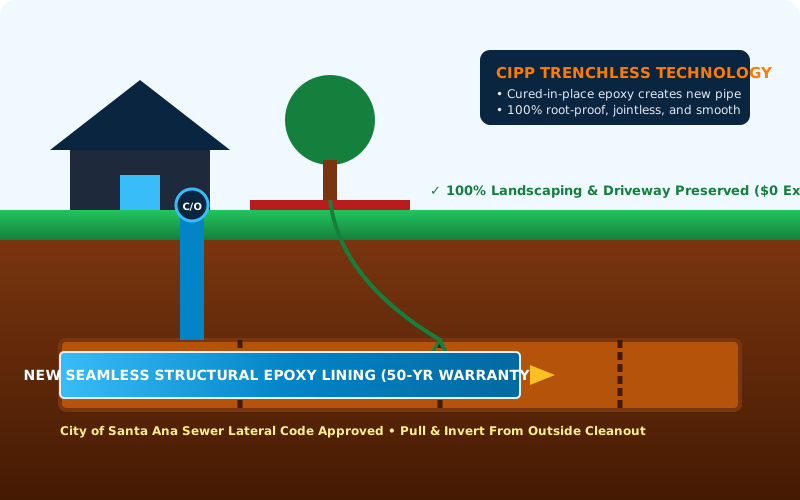
Historic neighborhoods like Floral Park, French Park, and Washington Square define the character of Santa Ana. However, beneath vintage cobblestone walkways and 80-year-old jacaranda canopies lie fragile vitrified clay sewer laterals installed during the Roaring Twenties. Traditional excavation destroys these irreplaceable heritage landscapes; CIPP trenchless relining preserves them.
The CIPP Relining Process: Step-by-Step
- Hydro-Mechanical Descaling: A high-definition robotic camera maps the line. We deploy 4,000 PSI hydro-jetting nozzles and carbide chain knockers to scour out 100% of tree roots, mineral calcification, and tar down to bare clay.
- Vacuum Epoxy Impregnation: A tubular non-woven polyester felt liner is calibrated to the pipe diameter and saturated under vacuum with structural epoxy resin.
- Pneumatic Inversion: Using air pressure, the flexible liner is inverted through the cleanout, pressing tight against the host pipe walls from the home foundation to the street sewer.
- Steam / Hot Water Curing: Pressurized steam cures the resin into an airtight, glass-smooth structural pipe within 2 to 3 hours.
- Robotic Branch Re-instatement: If auxiliary lines tie into the lateral, robotic cutters enter the pipe to reopen branch connections seamlessly.
Historic Property Constraints in Floral Park and French Park
Unlike tract subdivisions with open front lawns, historic districts in Santa Ana present strict landscape and structural constraints that make open-trench excavation physically hazardous or legally restricted:
- Protected Specimen Trees and Root Zones: Deep heritage jacaranda, California live oak, camphor, and ficus trees possess expansive root systems protected under municipal urban forestry guidelines. Cutting a 6-foot-deep trench across their primary structural root zone compromises tree stability and can cause mature canopy death.
- Hand-Laid Flagstone & Imported Masonry: Many historic Santa Ana driveways and walkways feature hand-chiseled flagstone or vintage clinker brick laid in custom sand mortar. Demolishing and recreating these historic masonry features can easily add $8,000 to $18,000 to an excavation project, far exceeding the cost of the plumbing work itself.
- Foundation Footing Proximity: Historic homes constructed with unreinforced masonry stem walls or shallow perimeter footings can suffer structural settlement and stucco cracking if open-trench excavation destabilizes adjacent soil compaction. CIPP relining leaves subterranean soil density 100% undisturbed.
CIPP Technical Longevity and Hydraulic Performance
Homeowners often wonder if a liner that cures inside an old pipe is truly permanent. Rigorous ASTM F1216 testing certifies that CIPP liners possess a minimum 50-year structural design lifespan. Because cured epoxy resin exhibits an ultra-low Manning roughness coefficient (n = 0.009) compared to aging clay (n = 0.013) or rough cast iron (n = 0.015), wastewater velocity and carrying capacity actually improve by 20% to 30%, despite the 3mm to 4.5mm reduction in internal diameter.
Real Local Job Study: Floral Park Jacaranda Preservation
Floral Park Heritage Estate Sewer Rehabilitation
Date: August 12, 2026 • Location: Victoria Dr, Floral Park, Santa Ana, CA
Issue: A 1928 Spanish Revival home had severe tree root blockages every 6 weeks under a 60-year-old jacaranda tree and hand-carved flagstone walkway. Open trenching would have killed the tree.
Solution: We hydro-jetted the roots through an existing exterior cleanout and inverted 72 linear feet of Perma-Liner CIPP epoxy structural liner.
Outcome: Completed in 6 hours. Zero landscaping damage. 50-year transferable warranty issued. City of Santa Ana Building Division inspection tag #SA-CIPP-409 signed off on the same afternoon.
Permits, City Inspections, and Environmental Safety
The City of Santa Ana Building Division enforces clear standards for trenchless rehabilitation. A plumbing permit must be secured, and our team provides pre-lining and post-curing high-definition digital video inspections documenting full lateral diameter recovery, joint sealing, and zero resin bypass. CIPP resins deployed by our technicians are 100% styrene-free and environmentally inert once cured, preventing any chemical leaching into Orange County groundwater tables.
Frequently Asked Questions
Common questions from Santa Ana property owners:
Will CIPP trenchless relining reduce my sewer pipe diameter?
The felt and epoxy liner is only 3mm to 4.5mm thick. Because the cured epoxy interior is glass-smooth (Manning roughness coefficient n=0.009 vs clay n=0.013), flow velocity actually increases despite the tiny reduction in diameter.
How long does cured-in-place pipe lining last?
CIPP epoxy structural liners carry an engineered ASTM design lifespan of 50+ years, resisting chemical corrosion and root penetration with zero seams.
Do I need a City of Santa Ana permit for trenchless sewer relining?
Yes. The City of Santa Ana requires an official plumbing permit. We submit before-and-after video recordings to the city engineering department for final sign-off.
Need Code-Compliant Plumbing in Santa Ana?
Direct mobile dispatch across Santa Ana and Orange County. 25–40 minute local arrival with $0 overtime surcharges 24/7/365.
Need Professional Trenchless Sewer Repair in Santa Ana?
We provide fast 25–40 minute emergency arrival, upfront flat-rate pricing, and complete repairs backed by our 25-year warranty.