
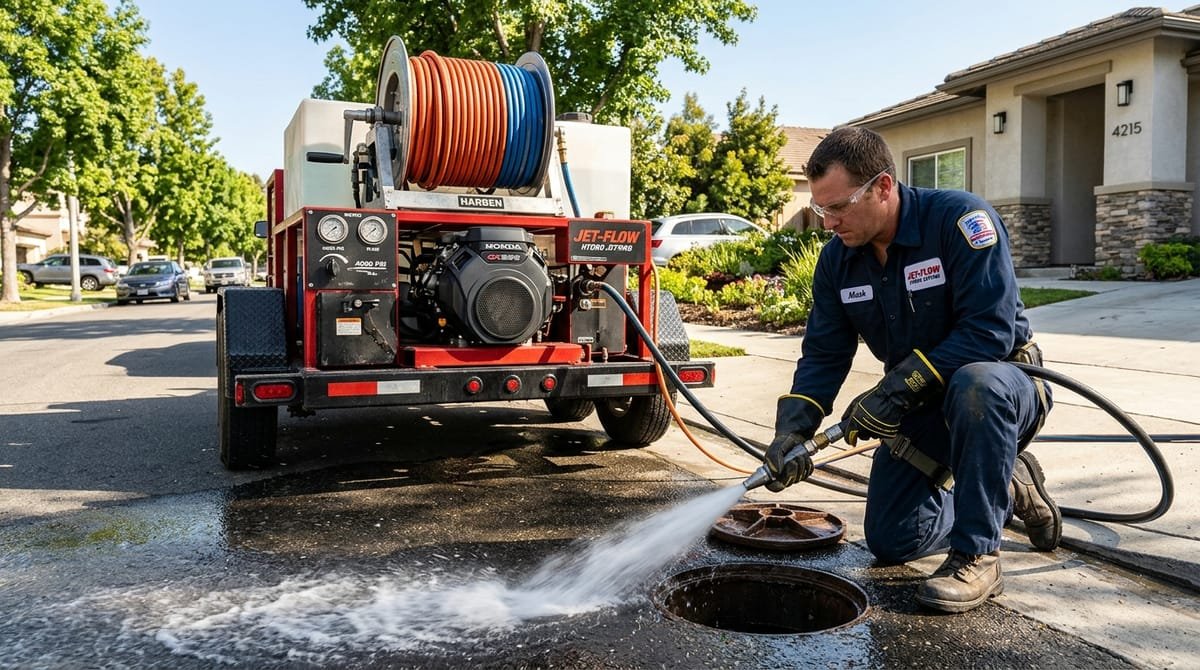
When tree roots invade a residential sewer lateral in Santa Ana, homeowners frequently ask why a simple $95 snake clearing failed to prevent another toilet backup just three months later. Understanding the physics behind mechanical snaking versus high-pressure hydro-jetting reveals why snaking alone is only a short-term band-aid.
What a Mechanical Drain Snake Actually Does
A mechanical drain snake utilizes a rotating steel auger cable driven by an electric motor. When inserted into a 4-inch or 6-inch sewer pipe:
- The spinning auger tip drills a hole through the center of the root ball, pushing enough debris downstream to allow water to drain.
- The cable rides along the bottom channel of the pipe, leaving 70% to 80% of the root mass clinging tightly to the upper and side walls.
- Ficus and jacaranda root fibers respond to mechanical cuts like pruned hedges, sending out dense new hair roots within 60 to 90 days.
What 4,000 PSI Hydro-Jetting Actually Does
Hydro-jetting utilizes commercial-grade equipment delivering up to 18 gallons of water per minute at 4,000 pounds per square inch of pressure through a steel nozzle with forward-penetrating and reverse-scouring jets:
- Rotary Carbide Cutters: Specialized root-cutting nozzle heads sheer off thick fibrous roots flush with the pipe wall.
- 360-Degree Wall Scouring: Reverse propulsion jets strip away hardened kitchen grease, paper sludge, and mineral scale, leaving the pipe interior smooth.
- Flushes Debris Completely: The intense water volume washes severed root debris out to the municipal street sewer, preventing downstream clogs.
Direct Comparison: Blockage Type & Permanent Fixes
| Blockage Obstruction | Drain Snake Result | 4,000 PSI Hydro-Jet Result | Permanent Engineered Solution |
|---|---|---|---|
| Hair & Soft Sink Clot | 100% Cleared (Effective) | Overkill for minor sink trap | Standard mechanical snaking ($95–$185) |
| Heavy Kitchen Grease | Punches narrow hole; re-clogs quickly | 100% Emulsified and scoured | Quarterly hydro-jetting ($350–$550) |
| Invasive Tree Roots | Restores temporary flow (30–60 days) | 100% Severed to bare pipe wall | Jetting followed by CIPP sewer lining |
| Hard Water Scale | Cable bounces off; no effect | Breaks apart calcium scale | Chain knocker jetting + water softening |
When Hydro-Jetting Is the WRONG Choice
Hydro-jetting is extremely powerful, and ethical plumbers will not use it blindly. High pressure should never be applied to:
- Severely collapsed or structurally crushed clay or Orangeburg pipes.
- Heavily offset joints where high-pressure water could undermine surrounding soil bedding.
- Thin-walled galvanized pipes experiencing structural channel failure.
We perform a mandatory fiber-optic camera inspection prior to jetting to confirm your pipe is structurally sound.
Frequently Asked Questions
Common questions from Santa Ana property owners:
Will 4,000 PSI hydro-jetting damage my older plumbing pipes?
Not when matched correctly to pipe condition. We camera the line first to inspect structural integrity. Pressure and nozzle rotation are adjusted to scour roots cleanly without harming the host pipe.
How often should a residential sewer line be hydro-jetted?
For properties with mature jacaranda or ficus trees in Santa Ana, hydro-jetting every 18 to 24 months prevents severe root intrusions from causing sudden structural sewer backups.
Does hydro-jetting permanently stop tree roots from returning?
Jetting completely clears the root mass inside the pipe, but does not seal the joint where roots entered. To permanently prevent regrowth, we install a seamless CIPP epoxy liner after jetting.
Need Code-Compliant Plumbing in Santa Ana?
Direct mobile dispatch across Santa Ana and Orange County. 25–40 minute local arrival with $0 overtime surcharges 24/7/365.
Need Professional Hydro Jetting in Santa Ana?
We provide fast 25–40 minute emergency arrival, upfront flat-rate pricing, and complete repairs backed by our 25-year warranty.